

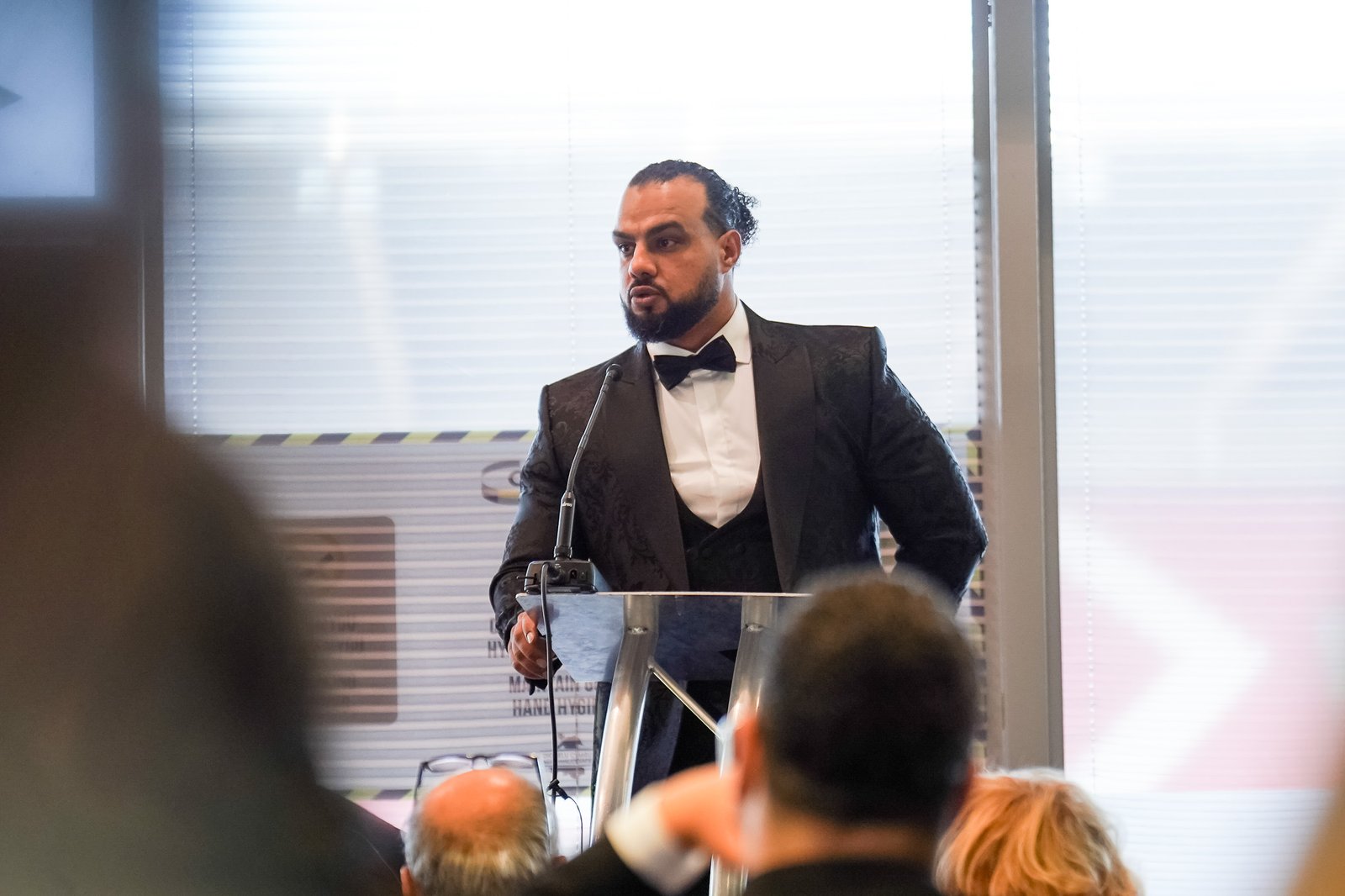
Bereavement powerhouse Ahmed Alsisi knows more about trauma than most. By Ruth Nicholas
Ahmed Alsisi is hard to miss and harder to ignore. Tall, broad, charismatic and with restless energy, he cuts a commanding presence.
Over the course of a two-hour interview, it becomes apparent that this accidental funeral director and Wales’s leading advocate for bereavement care takes advantage of his physical impact. Less visible is the
disparity between the powerful outline and the emotional hinterland that propels him to protect the vulnerable.
Alsisi is a suicide prevention activist, a member of cross party parliamentary groups, and a passionate advocate for aftercare for all vulnerable people. He trained as a chaplain to help prisoners and those who’d served their time. He set up the first Muslim funeral directors in Wales and embarked on a one man mission to educate the authorities about multi-faith practices so they could adopt a more compassionate approach. His annual bereavement conference has grown from 60 people in attendance to over 500. And he
somehow still finds time to write books and run the family business.
Born in a warzone and brought up in refugee camps, death was woven into the fabric of Alsisi’s young life – a daily reality as much as a spectral presence. “Fear, tragedy and loss were always part of my childhood,” he says. “Whether you lose close family members, or your neighbours have just been shot. As kids it was all we used to talk about: this person being killed or that person getting shot.”
Alsisi was born in a refugee camp in northern Gaza in 1989 during the civil war. Both his parents were medics, and his father especially was always on the frontline tending to the injured, routinely coming home covered in blood. “Going to school was quite scary because you never knew if he was going to make it back,” he says.
The danger from without these overcrowded camps was obvious; the danger within less so, but no less life altering. Alsisi was sexually abused as a young boy. “It wasn’t the most ideal place to live,” he says quietly. “In these camps, you never know who’s there.”
His way out arrived in 2000. His father had secured a scholarship to Cardiff University, but when war broke out again, his first thought was to return to his wife and family. “His professor said: ‘No, bring your family here.’ I remember receiving the email from my dad telling my mum we’d be coming to the UK,” Alsisi recalls. “We were very excited, but we very, very scared because we didn’t have enough money for the tickets, we didn’t have passports, we didn’t have a visa. And my mother was in her early 20s with four children traveling all the way from Gaza, going through the Sinai desert in a random taxi, to take a plane from Cairo to Paris then catch a transit to London. She only had very basic English – it was quite a journey.”
Cardiff came as a shock. “I didn’t have my cousins or my friends around. Being the only Palestinian, it was lonelier than lonely because, nobody relates to you, nobody understands you and nobody knows where you come from. I didn’t fit in within the Muslim community. I didn’t fit in with the white community. It made me
realise I’m on my own and that’s how my journey is going to be. I had to learn to live without friends quite
young. My friends were the books I read.
“I’ve gone through all sorts of pain so I see it straight away, even if someone is trying to mask it”
Alsisi had come from a close knit and conservative community “not extreme but very conservative” so the drinking, drug-taking, revealing clothes and social mores of his new home were unsettling, but nothing
compared with his experience of school. “There was a lot of bullying, a lot of racism, a lot of discrimination and a lot of fights,” he notes.
“I had a good grasp of Gaza. Back there, you had the sniper watching from a tower and you knew how to avoid him or get shot. I understood that, but racism and discrimination – I didn’t understand that because it was so nuanced.”
Worse was to come. “I think what affected me most was the kind of sexual abuse I received at school in this country,” he says.
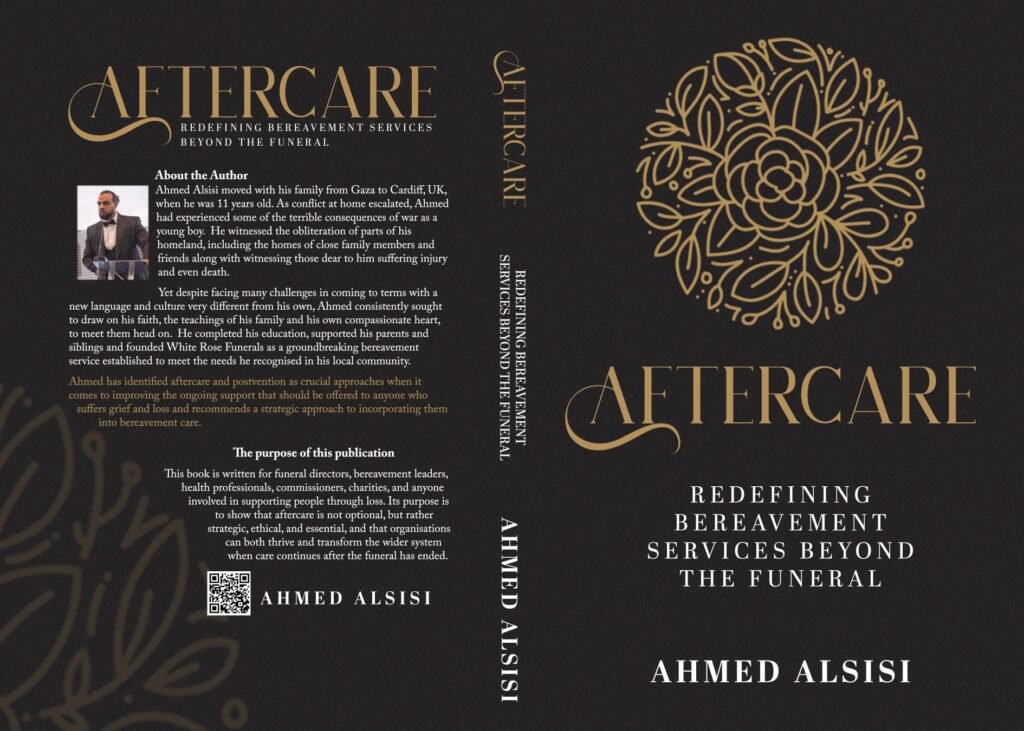
Throughout his teenage years Alsisi struggled. He found school academically unchallenging and in all other respects a different kind of warzone. College was better but “my post-traumatic stress disorder (PTSD) really caught up with me, I was having a lot of nightmares, I wasn’t sleeping much” he says. “At every stage of my life in the UK there was always a war in Gaza. I’d be up all night watching news, watching my family getting killed back home,” he explains.
Diagnosed with depression at a young age, Alsisi would eventually be diagnosed with complex (PTSD) and access support for adult survivors of childhood abuse. Coming to terms with his past has been a long road watered with many tears. Now the pain of those years fuels his determination to help others.
“It’s up to me: I can turn my pain into a reason to be a bad person or a purpose to be a better person. I don’t like to see people go through pain like I have been. And luckily for me, I’ve gone through all sorts of pain so I see it straight away, even if someone is trying to mask it. I cannot ignore it. So, I feel like my trauma has made me understand the world better and I don’t fall for the façade people put on every day,” he remarks.
Not being able to ignore things is what got him here. He became a funeral director because an imam issued a call for help arranging a funeral in accordance with Islamic rites. His work in suicide prevention started because a woman who had not long buried her baby couldn’t stand the pain and called him to say goodbye. His began educating the authorities when he saw the mental health cost on religious communities.
“When I was a kid, I used to look in the mirror and say: ‘I am destined to change something in this world’. I thought I’d be an engineer and create something that made a positive difference,” he says.
Perhaps he wasn’t so far off the mark after all.