

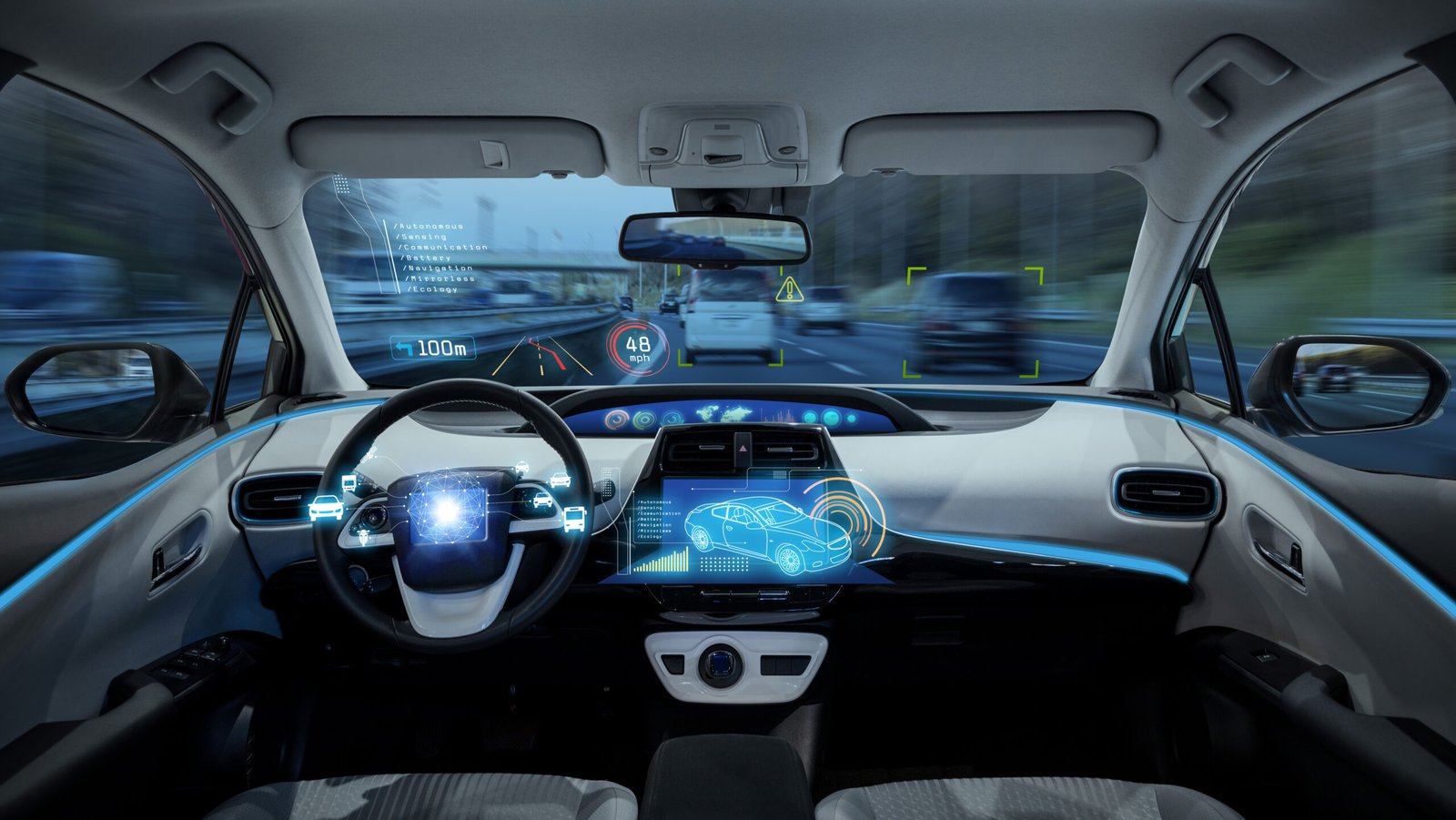
Patrick Quinn, director at Fearghas Quinn, ponders how advances in automotive technology, AI and robotics could reshape funeral vehicles and funerals themselves
As hearses and limousines are converted from passenger cars and as those vehicles benefit from ever more
sophisticated systems, coachbuilders have an array of new technology available to them for conversion.
The current generation of funeral vehicles, mostly built on platforms like the Mercedes-Benz W214 E-Class,
Volkswagen Passat or Ford Mustang Mach-E, arrive from the factory with a level of active technology that would
have seemed extraordinary a decade ago.
Advanced Driver Assistance Systems (ADAS) are now standard rather than optional on most base vehicles. Lane-keeping assist, automatic emergency braking, blind-spot monitoring, adaptive cruise control: these are no longer premium features, they’re the baseline.
For coachbuilders, this creates a specific set of challenges that rarely get discussed in wider circles. Radar and camera systems
are calibrated to a factory specification. Extend a vehicle, and you are working with a platform whose sensors were not
designed for its new geometry. Rear radar calibration, camera sightlines, and parking sensor logic all require careful attention, integrated design, and reprogramming during conversion.
The vehicles are smarter than ever. They are also, from a coachbuilder’s perspective, more demanding than ever.
Then there is electrification. The shift to electric powertrains is well underway across the passenger car sector, and the funeral market is being pulled alongside. The cortege, which by its nature travels short distances at low speeds, is actually well suited to electric power. The
barriers are practical ones: charging infrastructure, range certainty, battery reliability, and the engineering constraints that come with conversion. None of these is insurmountable, and the tide is heading in only one direction. Steer-by-wire, where the physical connection between steering wheel and road wheels is replaced entirely by electronic signals, is already present in
some production vehicles, including recent Lexus models. The mechanical column disappears, and the implications for vehicle design could be significant. Fewer constraints on internal layout means the spatial logic of a vehicle could be completely rethought.
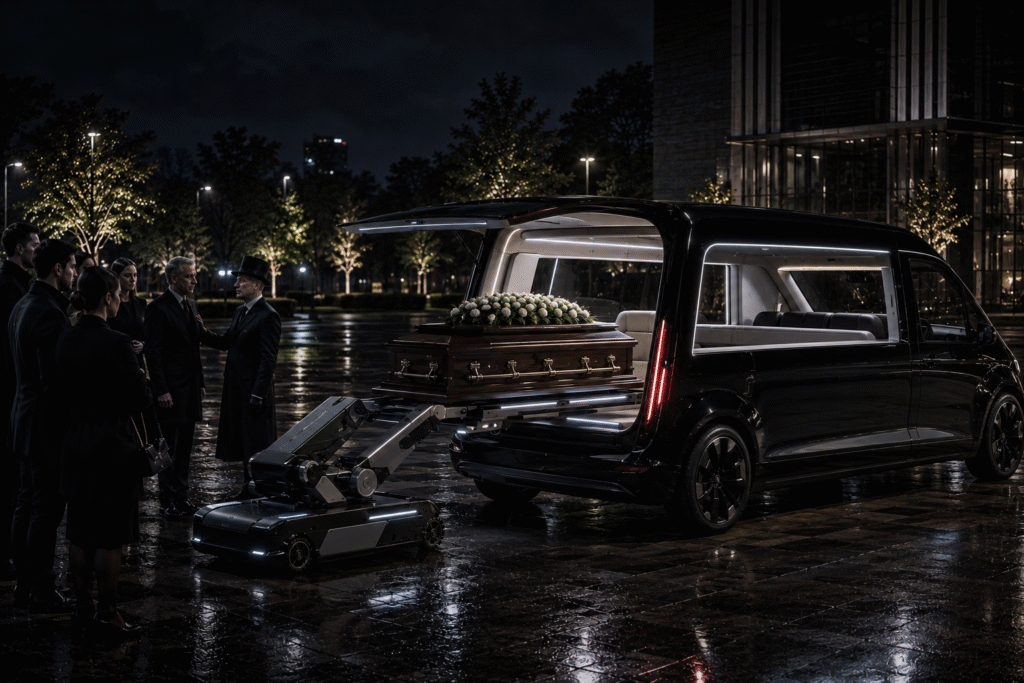
Autonomous driving, true hands-off, eyes-off autonomy at low speeds, is likely to reach operational viability for
controlled environments within the next decade. A slow-moving cortege on a pre-mapped, pre-programmed route is, from
a technical standpoint, one of the more manageable autonomous driving scenarios that exists. The regulatory and social
questions are harder than the engineering ones. But the capability will be there.
The explosion of AI could prove to be a turning point.
AI camera-assisted robots can already scan and map a vehicle panel in real time and determine the optimal method to paint it, adapting on the fly rather than repeating a fixed programmed path. Applied to autonomous driving, this same technology can map obstructions in unpredictable environments, such as older cemeteries with narrow access roads and uneven ground, and provide the kind of real-time safety assurance that could help satisfy regulators.
It is worth considering whether the funeral sector might actually be an ideal environment to introduce self-driving technology at scale: repeatable journeys, low speeds, and professional oversight throughout. Speculating on where all of this leads
is either impossible or irresistible, depending on your disposition. Here is one version of what it might look like.
A ceremony takes place at the funeral home. Coffin front and centre. At its conclusion, the coffin begins to move.
It is carried by a compact robotic transporter, similar in principle to those already moving pallets around warehouses, slowly and steadily out past the congregation and towards the hearse. It loads the coffin onto the deck, and then tucks itself underneath, into its storage position below the floor. Like a Roomba finding its way back to its charging base, it knows where it belongs, and uses its AI-assisted camera system to navigate any obstacles along the way. While all of this happens, the funeral director is with the family. Not managing logistics, not coordinating the lift, not thinking about manual handling. Present. Available.
Doing the part of the job that no technology will ever replace. The hearse comes to life. Interior lighting illuminates the coffin and
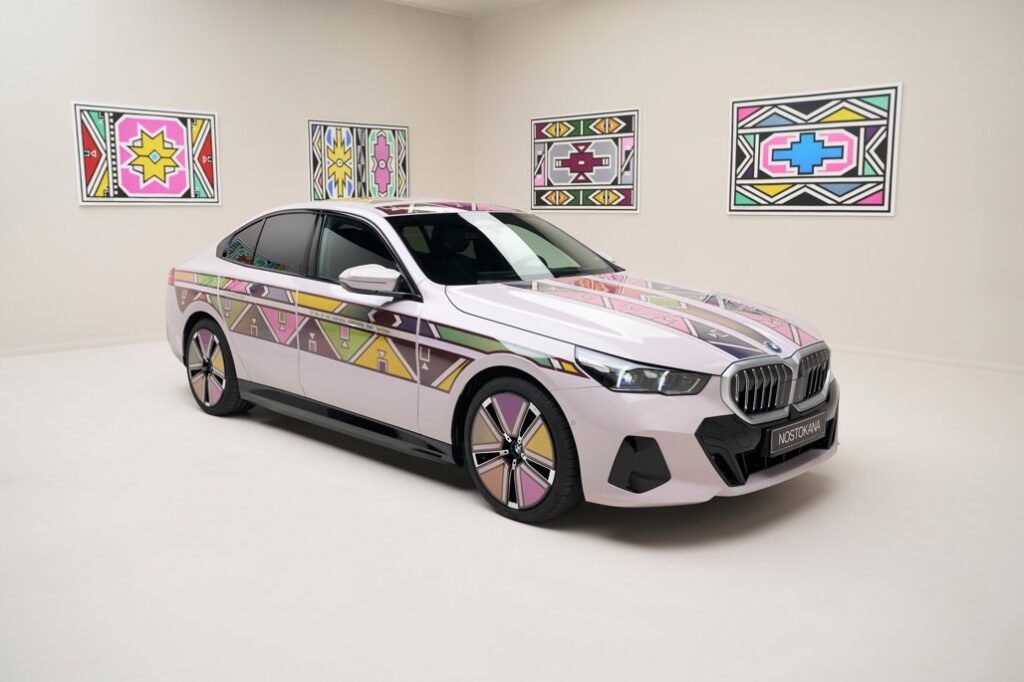
wreaths. The E-ink panels on the exterior arrange a personal message to onlookers as the vehicle passes through the town. (And if that sounds far-fetched, consider the fact that BMW has already filed patents for colour-changing technology based on E-ink that suggest it is production-ready and could be on road as soon as next year.) The funeral director walks ahead, keeping tradition alive. The hearse follows. Silent, or carrying music that meant something to the person inside.
At the final destination, the tailgate opens. The transporter climbs out, the coffin slides forward onto the platform, and it is carried the last distance to its resting place. None of this requires a single invention that does not already exist in some form. The robotic handling, the AI navigation, the E-ink panels, the autonomous low-speed movement: all of it is either here already or close enough to see from where we are standing. The funeral-specific application, getting the weight tolerances right, meeting the dignity requirements, integrating it into a working vehicle, is the engineering challenge. But it is a defined one.
From ADAS calibration on a stretched limousine to a robot that knows when the service starts, the through-line is the
same. Technology is not coming for the soul of the funeral trade. It is coming for the parts of the job that pull people away from the reason the trade exists in the first place.